IT CONSULTANCY
InvoiceNow Singapore: ERP Integration for GST Compliance
InvoiceNow is Singapore’s nationwide e-invoicing network built on the Peppol standard. It enables businesses to send structured invoice data directly between finance systems instead of relying on PDFs, email attachments, or manual re-entry.
For businesses preparing for the GST InvoiceNow requirement, the priority is no longer just digitising invoices. It is making sure your ERP, finance workflows, and submission processes are ready for compliance.
Onboarding InvoiceNow with a Smart IT Consultancy in Singapore
Neu Media Technology helps businesses implement InvoiceNow-ready workflows that connect invoicing, finance operations, and compliance in one practical rollout. Whether you are planning for new GST registration, replacing manual AP/AR processing, integrating InvoiceNow into your existing system, or setting up a brand new ERP system, we will help you move faster and smoother with our expertise, saving you time and money.
What Is InvoiceNow in Singapore?
InvoiceNow is Singapore’s nationwide e-invoicing network. It runs on the open Peppol framework and lets companies transmit invoice data directly from one finance system to another in a structured digital format. That means faster processing, fewer keying errors, and less dependence on paper or PDF invoices.
For GST-registered businesses, InvoiceNow is also becoming part of the tax compliance workflow. IRAS states that invoice data will need to be transmitted through InvoiceNow-Ready Solutions in phases, so businesses should prepare their systems early rather than wait until registration or filing deadlines create pressure.
Who Needs to Comply With GST InvoiceNow and When?
The GST InvoiceNow requirement is being rolled out in phases by IRAS.
- From 1 November 2025: companies that register for GST voluntarily within 6 months of incorporation.
- From 1 April 2026: all new voluntary GST registrants, regardless of incorporation date or business structure.
- From 1 April 2028 to 1 April 2031: the requirement expands in phases to new compulsory GST registrants and existing GST-registered businesses based on annual supplies.
If your business is planning GST registration, changing ERP, or scaling transaction volume, this is the right time to prepare your InvoiceNow setup.
How InvoiceNow Works With Your ERP
An effective InvoiceNow implementation should not sit as a disconnected add-on. It should fit naturally into your finance and ERP workflow.
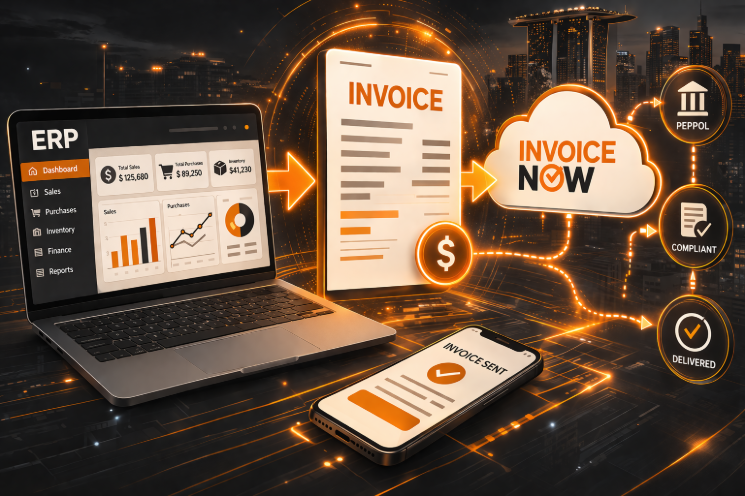
A typical InvoiceNow flow looks like this:
- Your finance team creates an invoice in the ERP or accounting system.
- The invoice is converted into the required structured format.
- The business is identified on the network using its Peppol ID.
- The invoice is transmitted via the InvoiceNow network.
- Where applicable, GST InvoiceNow submission features send invoice data to IRAS through the approved setup.
This matters because the business problem is not “how do I send an e-invoice?” It is “how do I reduce manual work, avoid compliance gaps, and keep finance operations clean inside my ERP?”
InvoiceNow Implementation Steps
IRAS’s onboarding path is straightforward in principle, but many teams still get delayed because the work touches tax, finance, operations, and system integration at the same time. IRAS says businesses using off-the-shelf solutions should check the accredited IRSP list, obtain a Peppol ID through registration in the SG Peppol Directory, and enable GST InvoiceNow submission. Businesses with in-house enterprise solutions should work with an accredited Access Point Provider to connect the solution and enable submission to IRAS.
Neu Media Technology recommends a five-step implementation plan:
1. Assess your compliance exposure
Are you preparing for voluntary GST registration, already GST-registered, or planning a finance-system change that should include InvoiceNow readiness?
2. Confirm your solution path
Use an InvoiceNow-Ready off-the-shelf solution or work with an accredited Access Point Provider for an in-house or complex enterprise setup.
3. Prepare master data and document rules
Validate customer and supplier data, invoice field mappings, tax treatment, and exception handling.
4. Enable submission and testing
Set up Peppol ID registration, transmission logic, and GST InvoiceNow submission features where needed.
5. Go live with finance controls
Train users, monitor rejections or mismatches, and keep audit-friendly documentation in place.
Why Businesses Choose InvoiceNow
Faster processing
InvoiceNow reduces dependence on manual data entry and helps shorten invoice handling cycles. IMDA describes InvoiceNow as a way to reduce business costs and shorten payment cycles.
Better data quality
Structured invoice data reduces rekeying mistakes and reconciliation issues. Competitor pages consistently position this as a top benefit because it is immediately felt by finance teams.
Better compliance readiness
IRAS is progressively mandating GST InvoiceNow participation, so businesses that prepare earlier have more room to test, clean data, and avoid rushed implementations.
Better ERP discipline
The strongest long-term value comes when InvoiceNow is connected properly to the ERP, not run as a siloed workaround.
FAQ for InvoiceNow

What is InvoiceNow in Singapore?
InvoiceNow is Singapore’s nationwide e-invoicing network based on the Peppol framework. It allows invoice data to move directly between finance systems in a structured digital format.

Is InvoiceNow mandatory in Singapore?
For GST InvoiceNow, yes, it is being introduced in phases by IRAS. The rollout starts with certain voluntary GST registrants and expands to other GST-registered businesses between 2025 and 2031.

What is the difference between InvoiceNow and Peppol?
InvoiceNow is Singapore’s nationwide e-invoicing network branding, while Peppol is the open international framework and technical standard it uses.

Can InvoiceNow work with an ERP system?
Yes. InvoiceNow is designed to transmit structured invoice data between finance systems, and IRAS supports both off-the-shelf InvoiceNow-Ready Solutions and in-house enterprise setups working through accredited Access Point Providers.

How long does implementation take?
Timing depends on your system complexity. IRAS says connection and testing for in-house enterprise solutions can be completed in as little as 3 months
Can SMEs adopt InvoiceNow?
Yes. IMDA positions InvoiceNow for companies of all sizes, and IRAS notes that accredited InvoiceNow-Ready Solutions may be eligible for government grant support.
Neu Media Technology's Commitment
Faster InvoiceNow Integration and Go Live Date
Neu Media Technology’s role is to help businesses operationalise InvoiceNow inside real finance processes,
not just switch on a connector.
-We translate GST InvoiceNow rules into an ERP-ready rollout plan.
-We help finance teams redesign invoice workflows, not just install a connector.
-We support data readiness, testing, and user adoption to reduce post-go-live friction.
-We focus on operational fit, not just technical activation.
 We map your current invoicing, approval, AR, AP, and GST-relevant workflows so the implementation matches how your finance team actually works
-
We help align InvoiceNow with your ERP, master data, customer-supplier records, invoice templates, and downstream finance processes.
-
We prepare your business for the GST InvoiceNow workflow, including data readiness, process checks, and the coordination needed with your chosen InvoiceNow-Ready Solution Provider or Access Point.
- As an
IMDA-accredited vendor, we support user adoption, internal SOP alignment, and rollout planning so your teams can use the system confidently after go-live.
OTHER ERP MODULES AVAILABLE
How We Help You Build a
Smarter Business with ERP

CRM
Keep leads from falling through the cracks.
Organize your sales pipeline, follow up at the right time, and close deals faster with smart lead tracking and built-in communication tools.

Sales
Quotes, orders, and invoices- all in one flow.
Create beautiful proposals in minutes, convert them to orders, and send invoices without switching tools or losing track.

Inventory
No more stock-outs or overstocking- quick.
Real-time inventory updates and tracking. Automate replenishment to ensure accuracy at top efficiency.

Accounting
Track finances with ease.
Manage receivables, tax invoices, vendor bills, expenses, and bank reconciliation- streamlined in one dashboard.

Purchase
Simplify procurement.
Compare vendors, automate POs, and control spending with visibility across all purchases and suppliers.

Manufacturing (MRP)
Plan, track, and manage production.
From raw materials to finished goods, get full visibility with real-time insights across operations.

HR & Payroll
Create employee management pipelines.
From attendance and payroll to performance tracking and manage the entire employee life cycle.

Website + eCommerce
Build a custom website with your ERP.
Sell online, integrate stock, and run promotions- no developer or third-party integration required.